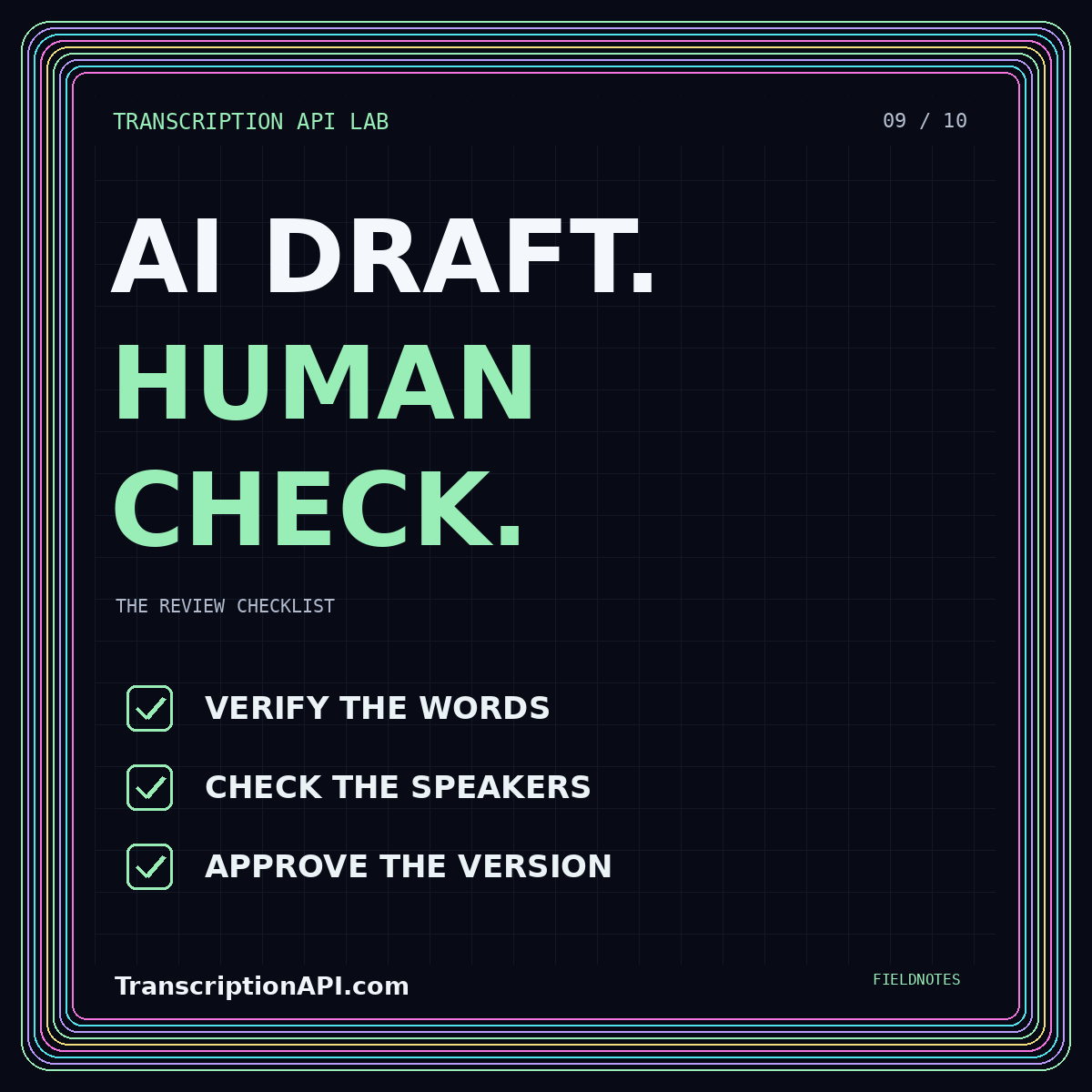
The AI transcriber review checklist: from machine draft to approval
Verify names, quantities, speaker assignments, uncertainty, and the final export before approving a transcript.
Read the field guideTHE DEVELOPER’S FIELD GUIDE TO SPEECH + AI
Build beyond the transcript. Explore speech-to-text APIs, evaluate AI accuracy, and design voice workflows that hold up beyond the demo.

Illustrative transcript · not a live recording
01 / THE GUIDES
From your first audio request to local AI pipelines, find the decisions that matter for the thing you’re building.
Design the contract between audio intake, recognition, review, and publication.
Explore the guideChoose a recognition configuration using repeatable evidence rather than a headline accuracy claim.
Explore the guideDiagnose and improve the audio boundary for calls, dictation, and voice notes.
Explore the guideTurn recognized speech into useful, correctly timed outputs for the actual destination.
Explore the guideEvaluate service fit through usable output, transparent assumptions, and clear ownership.
Explore the guideChoose the right transformation and preserve meaning through editorial and export steps.
Explore the guideDesign correctable speaker attribution without conflating voices, channels, and people.
Explore the guideEvaluate self-hosted recognition and optional LLM tasks as a complete operating system.
Explore the guideCreate an accountable path from machine draft to a transcript approved for a defined use.
Explore the guideUse transcript evidence in chat without losing source context or application control.
Explore the guidePrimary references and practical guidance. No invented benchmarks.
Recognition, interpretation, and action are different responsibilities.
Make uncertainty visible and preserve the source behind every result.
02 / CHOOSE YOUR STARTING POINT
A recording archive, a live conversation, and a local model need different architectures. Start with the experience you want to deliver—not the endpoint you saw in a demo.
Plan your integrationKeep recorded jobs durable. Separate the source asset, processing attempts, and the version approved for publication.
Illustrative application record · not an API response
{
  "asset_id": "recording_001",
  "mode": "batch",
  "output": [
    "text",
    "segments"
  ],
  "next_step": "human_review"
}
Your provider’s actual request and response fields will differ.
Treat changing text as provisional. Define how final segments are committed and what users see when a session is interrupted.
Illustrative application record · not an API response
{
  "session_id": "session_001",
  "mode": "streaming",
  "result_state": "provisional",
  "next_step": "await_final_segment"
}
Your provider’s actual request and response fields will differ.
Measure the full local workload. Keep recognition and optional LLM tasks separate, and map every place audio or text can travel.
Illustrative application record · not an API response
{
  "job_id": "local_001",
  "mode": "self_hosted",
  "recognition": "local_worker",
  "next_step": "review_before_llm"
}
Your provider’s actual request and response fields will differ.
03 / TRANSCRIPTION API LAB
Verify names, quantities, speaker assignments, uncertainty, and the final export before approving a transcript.
Read the field guide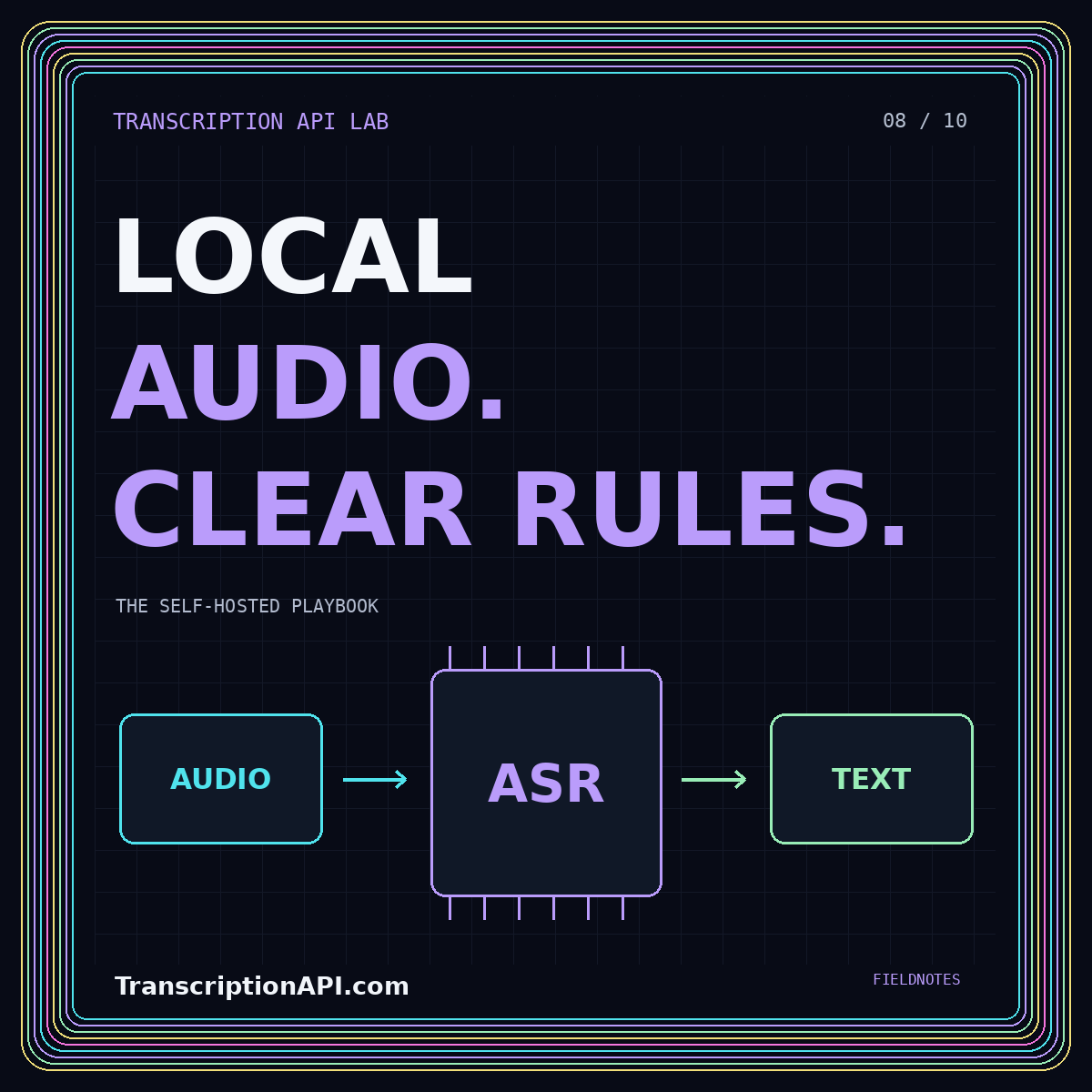
Separate local recognition from language processing, measure capacity, and map every storage and network boundary.
Read the field guide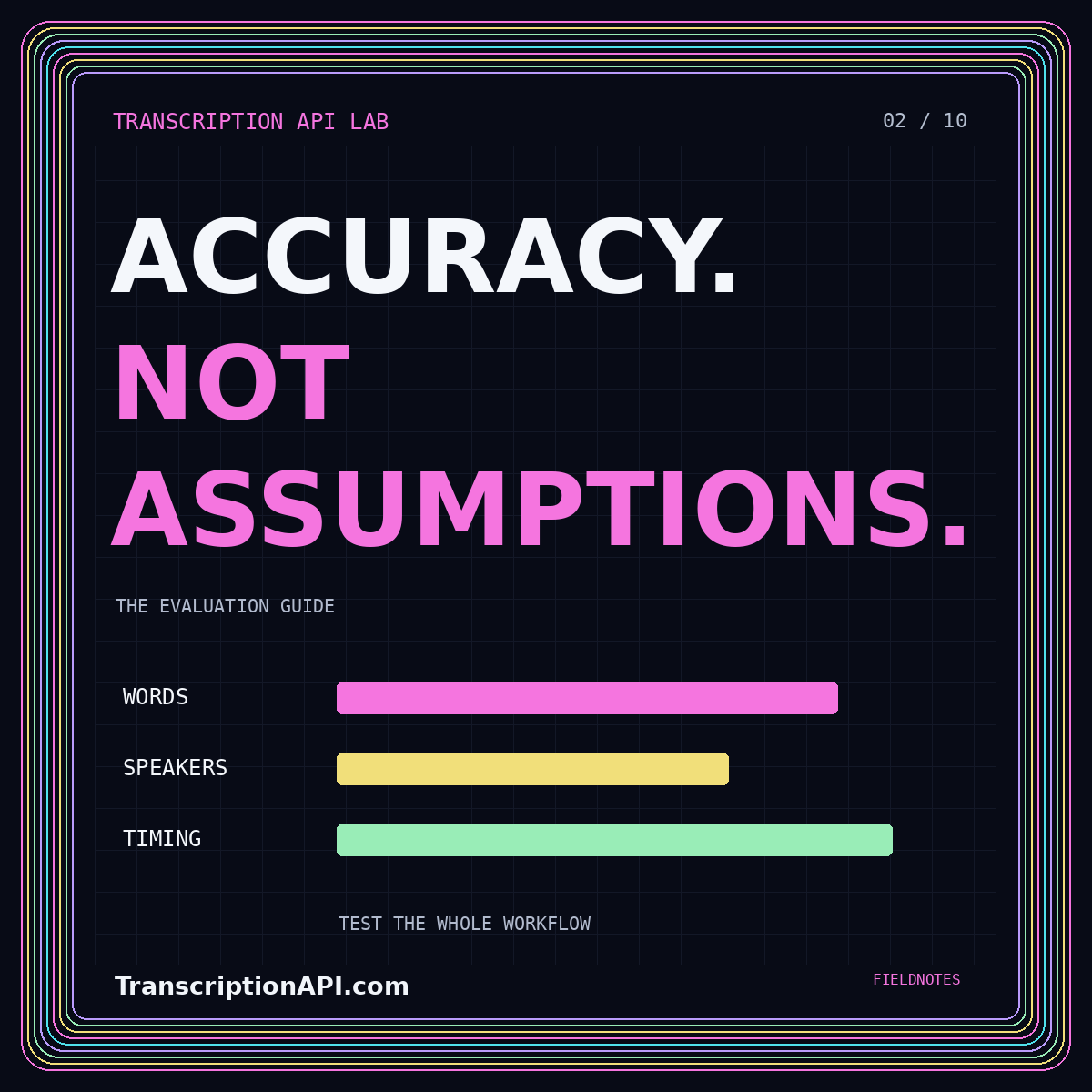
Build a representative test collection and measure the mistakes that matter beyond a headline accuracy score.
Read the field guide04 / A FEW GOOD QUESTIONS
Less guesswork. More context.
A clearer path from voice to useful text.
A transcription API accepts audio and returns recognized text, sometimes with timing or speaker information. Start with the integration guide to define the output and the job workflow your application needs.
Start with the user experience and data path. Recorded archives need durable completion; live experiences need careful handling of provisional text; local inference adds hardware and operational decisions. These choices can also be combined.
Use representative recordings, reviewed references, and a consistent evaluation method. Check meaningful mistakes such as names, numbers, negation, and speaker attribution. Read the accuracy evaluation guide before relying on a headline score.
A text-only model cannot process a recording merely from its filename. Your pipeline needs an audio-capable recognizer, with an optional language-model stage for the transcript. The local workflow guide separates these components.
No. TranscriptionAPI.com is an independent developer reference, not a hosted transcription service. There are no uploads, accounts, API-key forms, or recording tools on this website.
Email [email protected] with the relevant page and your suggestion. Please do not send private recordings, credentials, or sensitive transcript content.
Have a correction, a topic suggestion, or a workflow worth exploring?